Showing posts with label wildlife. Show all posts

Tuesday, October 30, 2012

The Last Asiatic Cheetahs Of Iran

When we hear Iran mentioned in the news, the images that immediately come to mind are war torn cities and military fighting; however, there is so much more to Iran than we know. Thinking of Iran, the one image that doesn't enter my mind is a cheetah, but there are Asiatic Cheetahs living and surviving in Iran’s “vast central plateau” (Hunter, National Geographic). There are only about 100 individuals left in Iran so they are extreme rarities among the desert landscapes. According to Dr. Luke Hunter, President of Panthera, “Iranian cats are virtually invisible […] intensely shy […] and hovering on the edge of extinction, they are essentially impossible to see” (Hunter, National Geographic).

Recently, National Geographic magazine published amazing photographs of wild Asiatic cheetahs in Iran gathered from those taken by camera-traps.  National Geographic was only able to photograph these rare cats due to an 11-year conservation project by the Iranian Department of Environment. In 2001, the DoE with support from the United Nations Development Programme, began a long-term project to bring the cheetah back from the edge of extinction. The Conservation of the Asiatic Cheetah Project (CACP) provided their own help by labeling five landscapes as specially protected cheetah reserves and provided numerous resources to make them remain safe havens—dozen of cheetah guards, new vehicles, motorbikes, and other materials. (Hunter, National Geographic)
Back in 2001, most Iranians had no idea their country harbored some of the Earth’s last Asiatic cheetahs, but now in cooperation with Panthera and local partners, the CACP sets out to protect the last Iranian cheetahs by
mitigating the direct threats facing cheetahs and their prey; gathering ecological data on existing cheetah, other carnivore and prey populations; enhancing and empowering law enforcement officials to protect cheetahs and their prey, including seeking a reduction in the number of annual gun licenses issued in cheetah range; researching the ecology of cheetahs, other predators and their prey using camera traps and radio-collars; studying cheetah rangelands to determine the extent of competition for land between livestock and the cheetah’s wild ungulate prey; establishing environmental educational activities with local communities to improve attitudes towards cheetahs; and engaging with local communities, conservation organizations and government officials to collaboratively protect cheetah habitat. (Hunter, Panthera)
In the past, the Asiatic cheetah’s distribution “extended across the Middle East, Central Asia, north into southern Kazakhstan and southeast into India;” however, today the cheetah has been pushed from almost its entire Asiatic range except for the “small and critically endangered population in the Islamic Republic of Iran” (Hunter, Panthera). The roughly 100 Asiatic cheetahs left in the wild occupy the “arid, central plateau of Iran” and face major threats which include: “overhunting of cheetah prey, habitat degradation and direct poaching” (Hunter, Panthera).
It’s important to get the word out about these elusive cats and to grab the attention of conservation organizations worldwide; that’s why the camera trap photos are so pertinent to the cheetahs’ survival. Currently, “Iranian cheetahs live at the lowest density recorded anywhere for the species, one to two cats per 1,000 square kilometers; the same-size area on East African plains can hold 100 cheetahs” (Hunter, National Geographic). National Geographic magazine’s article provides “evidence of residency and breeding including terrific pictures of young cubs” (Hunter, National Geographic). So, even though the cheetahs are at exceptionally low numbers, the camera trap photographs of the cheetahs and cubs provide hope for future populations.

Dr. Luke Hunter hopes that “National Geographic’s wonderful photographs bring the predicament of this critically endangered cat to a new audience who, like most Iranians a decade ago, had never heard of the cheetah’s existence in the country” (Hunter, National Geographic).

References
Hunter, Luke, Dr. "Finding the Last Cheetahs of Iran." News Watch. National Geographic, 25 Oct. 2012.Web. 30 Oct. 2012. 

Hunter, Luke, Dr. "Finding the Last Cheetahs of Iran." Panthera, 25 Oct. 2012. Web. 30 Oct. 2012.


Friday, September 28, 2012

Aerial Drones and Conservation

When it comes to wildlife conservation, much of it involves scientists searching through exotic forests and jungles collecting population data, setting camera traps, and surveying the ecosystem. As important as all this is, it takes up a lot of time and money. So the newest option for conservationists is to use aerial drones to assist them in surveying specific areas for wildlife and for human encroachment in the habitat.

By putting ‘an eye in the sky’ it’s easier to view large herds of elephants in Africa or the effects of deforestation on a habitat. A team of scientists working in Indonesia created “inexpensive unmanned aerial vehicles (aka drone airplanes), to study critically endangered Sumatran orangutans (Pongo abelii) from above the treetops” (Platt). This technology is already being used in other conservation projects around the globe.

Serge Wich, a professor at the Research Center in Evolutionary Anthropology and Paleoecology at Liverpool John Moores University, says “autonomous drones can help scientists and conservationists to inexpensively collect timely, high-resolution data” (Platt). Wich and his partner, Lian Pin Koh, assistant professor of applied ecology and conservation at ETH Zurich, “have developed a lightweight drone system that costs about $2,000—including the batteries, software, cameras and flight stabilizers” (Platt). Other available drones are much more expensive and can cost up to $5,000, but Wich and Koh set up a website, ConservationDrones.org, to help others recreate the same technology around the world.

Wich and Koh first used their drones in Sumatra “to capture video and photographs of orangutans and elephants. The drones also came back with striking images of Sumatra’s deforestation, caused by logging and palm oil plantations” (Platt). They also captured “photographs of orangutan nests high in the trees, information that will help inform future conservation activities” (Platt).

In an interview for the Scientific American blog, when asked what he was trying to solve with these drones, Wich replied that “one of the main problems we have is that we’re almost always behind the facts on the ground.” He goes on to describe how the conservation areas are just so huge and difficult to monitor regularly so the need for drones is high. The drones are available whenever they want to send them out, whereas conducting ground surveys takes time for planning and execution and the cost is considerably higher.

The beauty of the drones is that conservation researchers can choose to fly them as often as they like; for example, drones can fly over the forest every month or every week to see what’s going on. Then if there are any illegal activities or encroachment going on they can inform the local authorities. Wich hopes drones will enable conservationists “to react much faster to changes on the ground” than before (Platt).
Photo of deforestation

Eventually, as the drone technology advances, Wich wants to receive “live feedback from the video” instead of how it is now where he does not get access to video or photos until the drone returns from its flight (Platt). The drones currently operate with an autopilot route, much like Google Maps, that the researcher can plot himself. The next step after live video footage would be thermal imaging attached to the drone software.

Another example of aerial drones used in conservation is the research Panthera is currently conducting for the Jaguar Corridor Initiative. According to Panthera’s September newsletter, “one of the greatest resources shaping [Panthera’s] groundwork is aerial surveys carried out within Panthera’s Jaguar Corridor Initiative—a program working to connect and protect jaguar populations from Mexico to Argentina to ensure the species’ genetic diversity and future survival” (Panthera).
The drones offer “a unique perspective of the jaguar’s range, and a level of detail unmatched by satellite imagery, aerial surveys allow Panthera’s scientists to truly view connectivity of the Jaguar Corridor, identify encroachments on the jaguar’s range and pinpoint habitat in which to focus Panthera’s future conservation efforts.” The main threats targeted by these aerial drones are “habitat loss and fragmentation caused by increasing human populations and developments.” They also supply Panthera scientists with images to “visually demonstrate” to political leaders how the Corridor actually connects the jaguars throughout their range (Panthera).

In addition to population data, habitat status, and the health of the ecosystem, researchers hope drones will enable faster response times for antipoaching patrols. Panthera believes “local communities and local violators are recognizing the potential of aerial surveys to uncover otherwise unidentifiable illegal activities, and allow improved enforcements of forest protection laws.” Drones will definitely have a massive impact on the effectiveness of wildlife conservation around the world.


References:
Platt, John R. "Eye in the Sky: Drones Help Conserve Sumatran Orangutans and Other Wildlife,  Extinction Countdown, Scientific American Blog Network." Scientific American Blogs., 27 Sept. 2012. Web. 28 Sept. 2012. <http://blogs.scientificamerican.com/extinction-countdown/2012/09/27/drones-help-conserve-sumatran-orangutans-wildlife/>.

"September 2012 Newsletter." Panthera. Web. 28 Sept. 2012. <http://www.panthera.org/september-2012-newsletter>.

Tuesday, July 31, 2012

Wildlife Bridges: The Animal Friendly Infrastructure

How many times have you had to slam on the breaks because an animal ran into the road? And how many of those times have your reflexes not been quick enough? Roadkill is a tragic reality of today’s car culture. According to Co.Design, vehicle-animal collisions cost Americans a massive $8 billion a year. That’s one expensive reality; however, innovative design can help.

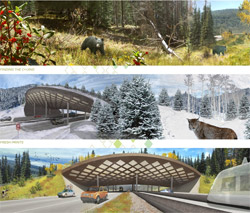
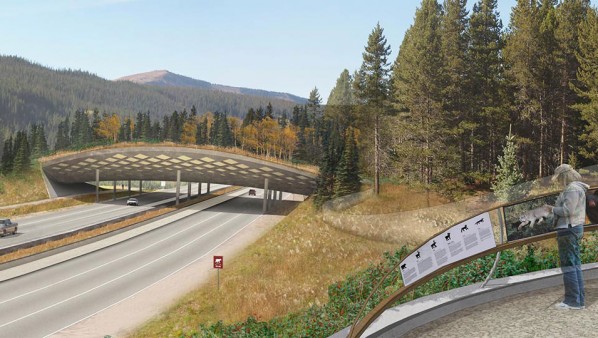
In 2010, Balmori Associates, a New York City landscape design firm, proposed building simple, inexpensive wooden bridges over highways, then covering them in native vegetation to create a wildlife crosswalk. Each bridge would be so wide and the greenery so diverse, it would appear like an extension of the forest, and animals, the thinking goes, would be less inclined to cross the road, resulting in fewer accidents (Kuang, Co.Design). Following this proposal, Balamori Associates came up with the ARC International Wildlife Crossing Infrastructure Design Competition which was the “first-ever international design competition…intended to solve the problem of ensuring safe travel for humans and wildlife” (Kuang, Co.Design). The main idea is to keep the bridge as low-tech and cost-effective as possible so it can be constructed anywhere in the United States without disrupting the road or the environment. 
ARC—Animal Road Crossing—is an interdisciplinary partnership working to expedite new ways to create wildlife crossing structures. ARC’s primary goal is “to ensure safe passage for both humans and animals on and across our roads” (arc-solutions.org). These wildlife crossings or bridges will extend wildlife corridors and enable a variety of species safe passage across America’s highways. In other words, “ARC is working toward the (re)design of our highways so that the need for safe passage is met safely and efficiently while also maintaining the integrity and connectivity of our ecosystems, reducing our carbon footprint, minimizing the consumption of non-renewable materials, recycling resources and extending the life cycle of transportation infrastructure” (arc-solutions.org).          

An interesting fact, one that I was not aware of,  is that most of North America’s major highways generally go east-west while most wildlife movements tend to follow major landforms and topography which generally run north-south (arc-solutions.org) therefore increasing the need for wildlife crossings. When the proposed wildlife crossing structures are designed and built correctly they “act as a new, visible layer of functioning landscape, weaving over and under our highways, in and out of the natural landscape” (arc-solutions.org). Given the range and variety of species throughout North America, each wildlife crossing needs to cater to the specific needs of the species it is designed to protect. For example, some species prefer overpasses, while others prefer underpasses.              
When building wildlife bridges it’s important to remember that they are “typically shorter in span but much wider [than vehicle bridges]. They also necessarily include a thick layer of soil and vegetation—a landscaped surface—that must emulate local habitats” (arc-solutions.org). ARC recommends an inverted arc shape to the wildlife bridge because it conveys the feeling of a valley for animals and results in more light for drivers. Another aspect of the wildlife bridges is education; viewing platforms for the public to actually observe animals crossing the wildlife bridges at a safe distance will encourage support among the public. If people can see what the bridge is protecting they will be more inclined to encourage it.  ARC emphasizes that “wildlife crossings are being designed as living experiments, complete with data-gathering technologies built into the structure. Wildlife crossings offer rich potential for learning: infrared cameras installed at crossing sites capture and record animals in transit; web cams transmit real-time wildlife movement data to science labs and classrooms alike; and hand-held applications [such as smartphone apps] bring the data to passengers in a passing car” (arc-solutions.org). 

If we can manage to get large numbers of these wildlife crossings built, they could reduce animal-vehicle collisions between 80 and 100 percent if designed correctly; with time, ARC believes wildlife crossings can eliminate the problem and the cost of such collisions entirely (arc-solutions.org). Good news is, wildlife crossings may be closer than you think. President Obama just signed a transportation bill on July 6, 2012 that “includes important provisions that will allow states and federal agencies to retrofit roads and create wildlife crossing structures that help prevent wildlife from colliding with the motoring public. The wildlife-vehicle collision provisions address roads on federal and tribal lands, national parks, and state highways” (arc-solutions.org/news)

One easy way to help ARC understand where wildlife vehicle collisions occur most is to go online and share your Road Story here.

Also, to see examples of camera trap photos of animals using the wildlife bridges please visit here.

Reference:
“Can a Wildlife Bridge Fix America’s $8 Billion Roadkill Problem?” Co.Design. Ed. Cliff Kuang. N.p., 02 Dec. 2010. Web. 31 July 2012. http://www.fastcodesign.com/1662800/can-a-wildlife-bridge-fix-americas-8-billion-roadkill-problem.

Saturday, April 28, 2012

Snowy Owls in Sight?


I doubt I’m alone when I say that whenever I see a snowy owl, I can’t help but think of Hedwig from the Harry Potter books by J.K. Rowling. In a way, Hedwig’s character has made children and adults more aware of snowy owls in the wild. These owls are described as “the most massive (greatest average weight) of the North American Owls and believed, by many, to be the most powerful” (Owling.com). The males “can be entirely immaculate white” but usually show a few “spots or bars of dark slatey brown or black on the crown, back, wings, and/or tail.”  Also, “his under parts are generally marked with narrow bars on the abdomen, flanks, and sides.” The female, on the other hand, is much more heavily barred in a blackish color and considerably larger than the male. “Only her face, center part of breast, and back of neck are unmarked white.” Compared with other owls, both the male and female snowy owls have small, brilliant yellow iris.  Snowy owls have feathered feet, large sharp talons, and dull black bills that are almost buried in its fluffy white feathers. And it’s almost totally silent outside its breeding grounds.
The Snowy Owl inhabits the northern tundra around the world. Generally, the Snowy Owl inhabits “areas of low sparse vegetation, open fields, moorland, valley floors, salt and poorly drained fresh water meadows. Its habitat is closely associated with the distribution of small rodents and in the case of breeding territory directly corresponds with the distribution of small rodents (especially lemming). In the winter months, snowy owls are often found in farming areas with open fields of low stubble, marshes, and even dunes” (Owling.com).

As Snowy Owls migrate south for the winter months, we may see many more than expected. According to Sierra magazine, 2012 may be the year of the snowy owl. This winter, researchers at the Cornell Lab of Ornithology, have witnessed increased numbers of these birds of prey venturing farther south than usual. After summering in the northern tundra of the Arctic hunting and nesting, snowy owls normally migrate through Canada and the northern U.S. in the winter to search for food. Due to an abundance of prey (lemmings and small rodents) last summer, the snowy owl population experienced a growth which offset the predator-prey ratio. As a result, snowy owls are now experiencing greater competition for food. Therefore, the birds must fly farther south from their usual habitat to ensure better access to prey.
The rise in the snowy owl population is good news in itself, but it’s also great news for birders. The chance to get a glimpse of one of the largest owls on the planet as far south as Texas continues to occur through the end of April. So keep your eyes peeled and cameras at the ready!

All information regarding Snowy Owl biology from Owling.com
News article: Sierra Magazine

Wednesday, January 4, 2012

Eat Chocolate…Save the Planet


Wouldn't it be great if eating chocolate meant helping the environment? Well, that’s exactly what happens when you buy Endangered Species Chocolate! The tag-line for this chocolate brand is “Savor chocolate. Save our planet.”

Endangered Species Chocolate offers “premium, all-natural, ethically traded, naturally shade grown chocolate products” that are guaranteed to contain beans purchased from family-owned properties where the income directly benefits the community. Furthermore, 10% of the company’s net profits are donated to fund species and habitat conservation efforts around the world.
Endangered Species Chocolate offers a variety of ways to give back through chocolate. For example, you can simply walk into any natural or conventional grocery store, large or small, throughout the U.S.A. and Canada to buy one chocolate bar.


Or, you can visit the Endangered Species Chocolate website for a larger commitment to conservation and appetite. Chocolates are available to buy in bulk, as party favors, or as a gift. Within the gift collections are special AWF (African Wildlife Foundation) collections that are a bit more expensive, but include a $15 donation to the African Wildlife Foundation as well as a 1-year AWF e-membership, an AWF plush animal (elephant, leopard, gorilla, lion, zebra, giraffe, rhino, wild dog, or wart hog) of your choice, and 3 Endangered Species All-Natural Chocolate Bars.

So, next time you’re craving something sweet, whether it’s one chocolate bar or a gift collection, put your taste buds to work for endangered species and their habitats!


*All information pertaining to Endangered Species Chocolate can be found here.

Sunday, August 21, 2011

Meet the Sand Cat

The Sand Cat is one of the lesser known and smaller wild cats, resembling the domestic cat in size; the Sand Cat’s coloring helps it blend with those of its desert habitat. Over time, it also developed large eyes placed forward on its broad head and low, tapered ears to provide keen hearing in a habitat where prey is scarce. Another adaptation developed specifically for its desert habitat is the presence of long, dense hairs covering the soles of the feet to provide insulation from the hot sands and to create quiet footsteps over the loose sands.

Sand Cats differ greatly from their fellow African cats such as leopards because instead of jumping and climbing, digging is their forte. A Sand Cat uses digging to construct burrows and dig rodents out of the sand. Also opposed to the more familiar African cats, a Sand Cat’s claws are not very sharp as there is usually little chance to sharpen them among the desert sands.  
A Sand Cat’s diet consists of gerbils, jerboas, sand voles, hares, birds, reptiles, large spiders, and insects. They also have a reputation for hunting horned snakes and sand vipers by stunning them with rapid blows to the head before finishing them with a bite to the neck—the go to kill technique of most wild cats. Furthermore, Sand Cats cover larger kills with sand and return later to finish the meal. Their natural enemies include poisonous snakes, jackals, and large owls.
Like lions, Sand Cats are nocturnal hunters; however, they are solitary animals and their numbers in the wild are unknown.

Most threatened or endangered species today suffer from habitat destruction, the Sand Cat does not since its habitat is located in the vast deserts of northern Africa and southwest Asia. Sand Cats have little interaction with humans because they are usually sleeping when people are active in and around the deserts. On the other hand, this small cat does experience threats from hunters while sunbathing and the illegal pet trade.

One advantage the Sand Cat has over other wild animals living close to humans and their farms is usually there is no retaliation if a Sand Cat happens to steal a chicken or two because of religious tradition. Apparently, Sand Cats are believed to be the companions of the Prophet Mohammed and his daughter. That’s certainly an advantage that cannot be replaced.

An SSP (Species Survival Program) was established for Sand Cats by the Living Desert Museum in California in 1990. This is one of few studbooks for small wild cats. One zoo in the United States participating in the SSP is the Cincinnati Zoo. The Cincinnati Zoo currently works in collaboration with the Living Desert Zoo in California, other U.S. zoos, and the Al Ain Zoo in the United Arab Emirates to produce new founders for the SSP population. With so much devotion and the continued effort of the SSP, the Sand Cat’s future looks bright.


*All facts and information regarding the Sand Cat from the International Society for Endangered Cats and the Cincinnati Zoo & Botanical Garden
*All photos from ARKive

Saturday, January 29, 2011

African Cats: Earth Day 2011


On April 22, 2011 audiences will be given the chance to peek into the lives of two families of African Cats simply trying to survive in one of the wildest places on earth: the African Savanna. It’s as if Disneynature has brought my favorite childhood movie, “The Lion King,” to life for us all to witness on screen. Directed by Keith Scholey and Alastair Fothergill, this epic story “features Mara, an endearing lion cub who strives to grow up with her mother’s strength, spirit and wisdom; Sita, a fearless cheetah and single mother of five mischievous newborns; and Fang, a proud leader of the pride who must defend his family from a once banished lion” (Disney).


On the surface, this may appear to be a simple nature documentary; however, at its roots this movie strives to educate the audience on the need to preserve the African Savanna. For example, if you go see “African Cats” during opening week, “Disneynature will make a donation in your honor to protect lions and cheetahs and the land they call their home” (Disney). Specifically, “Disneynature will contribute $0.20 per ticket to the African Wildlife Foundation for the Amboseli Corridor project […] (April 22-April 28) with a minimum of $100,000 pledged to this program” (Disney).
Unlike humans who build a home and usually remain there for the duration of their lives, the big cats of the African Savanna know no boundaries. The lions, cheetahs, and leopards of the Savanna cannot comprehend the boundaries of a National Park; therefore, they tend to travel between protective areas through “corridors.” Corridors are pertinent to these roaming kings and queens of the Savanna because they connect different territories and hunting grounds frequented by the big cats for both habitat and food. Furthermore, by protecting the African Savanna with the African Wildlife Foundation you not only protect Africa’s big cats but also the African elephants, zebras, giraffes, and elands (antelope).
The African Wildlife Foundation works tirelessly to ensure the continued existence of all African Savanna wildlife, yet help is still needed! So, on Earth Day 2011, go see “African Cats” in theatres and know that you have helped make a difference in the conservation of the African Savanna and its wildlife.