Showing posts with label cheetah. Show all posts

Tuesday, April 9, 2013

Earth Day 2013


Earth Day is April 22, 2013; it is a day of environmental service and awareness. The best way to celebrate is to get outside and help make a difference for Mother Earth. Ways to get involved include cleaning up at your local river, planting trees at your local park, or volunteering to help animals who depend on the habitats around you. For example, you could help build bird houses or nest boxes for birds during the breeding season. If you can’t get outside, then donate to a favorite environmental organization; donating money enables others at the organization to take action when you can’t take it yourself. Advocacy and donation can be just as rewarding as getting outside because you’re inspiring others to take action.
One of my favorite non-profit organizations is Panthera, an organization devoted to wild cat conservation around the world. They strive to protect lions, tigers, jaguars, snow leopards, cheetahs, cougars, and leopards. In my eyes, big cats are some of the most majestic creatures on earth. And even though I can’t make the journey to help make a difference in person, I can still advocate for and donate money to the numerous Panthera projects targeted at protecting both the big cats and their habitats. The Panthera programs include: Save the Tiger Fund, Tigers Forever, Lion Guardians, Project Leonardo, Pantanal Jaguar Project, Jaguar Corridor Initiative, Snow Leopard Program, Munyawana Leopard Project, California Cougar Project, Teton Cougar Project, and the Iranian Cheetah Project.

The lion is the big cat currently facing the most danger. According to a recent press release, Panthera estimates lions at fewer than 30,000 individuals living in just 25% of their original natural habitat. The press release centers around a newly published report co-authored by “a large team of lion biologists, including Panthera’s President, Dr. Luke Hunter, and Lion Program Director, Dr. Guy Balme, entitled Conserving large carnivores: dollars and fence, published in the scientific journal Ecology Letters, that concludes nearly half of Africa’s wild lion populations may decline to near extinction over the next 20-40 years without urgent conservation measures" (Panthera).
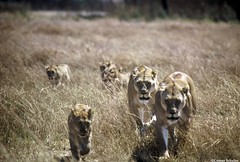
The main conservation measure discussed in the report is the installation of fences in and around Africa’s wilderness. Many scientists believe the best chance lions have to survive is to be separated from humans by wildlife-proof fencing. The largest threats lions face are from “human communities, including retaliatory killing by herders, habitat loss and fragmentation, and overhunting of lion prey” (Panthera). Even though the report shows that fences keep conservation costs lower and more lions survive in fenced-in ecosystems rather than unfenced, Dr. Luke Hunter explained that “No one wants to resort to putting any more fences around Africa’s marvelous wild areas [however,] without massive and immediate increases in the commitment to lion conservation, we may have little choice” (Panthera).

There will never be just one solution, but it’s clear that separating human and lion populations is essential for their ultimate survival. In addition to physical boundaries, Panthera conducts “conflict mitigation initiatives such as Project Leonardo and the Lion Guardians Program” in order to reduce lion-human conflict.

To learn more about all of Panthera’s programs to protect the world’s big cats, please visit Panthera.org.

On Earth Day this year, please remember that it’s not just your actions on this one day that matter, but the actions you take year-round to make a difference for the earth and all animals that call it home.

For more information on Earth Day 2013 and to find an Earth Day celebration in your area, please visit the Earth Day Network

Tuesday, October 30, 2012

The Last Asiatic Cheetahs Of Iran

When we hear Iran mentioned in the news, the images that immediately come to mind are war torn cities and military fighting; however, there is so much more to Iran than we know. Thinking of Iran, the one image that doesn't enter my mind is a cheetah, but there are Asiatic Cheetahs living and surviving in Iran’s “vast central plateau” (Hunter, National Geographic). There are only about 100 individuals left in Iran so they are extreme rarities among the desert landscapes. According to Dr. Luke Hunter, President of Panthera, “Iranian cats are virtually invisible […] intensely shy […] and hovering on the edge of extinction, they are essentially impossible to see” (Hunter, National Geographic).

Recently, National Geographic magazine published amazing photographs of wild Asiatic cheetahs in Iran gathered from those taken by camera-traps.  National Geographic was only able to photograph these rare cats due to an 11-year conservation project by the Iranian Department of Environment. In 2001, the DoE with support from the United Nations Development Programme, began a long-term project to bring the cheetah back from the edge of extinction. The Conservation of the Asiatic Cheetah Project (CACP) provided their own help by labeling five landscapes as specially protected cheetah reserves and provided numerous resources to make them remain safe havens—dozen of cheetah guards, new vehicles, motorbikes, and other materials. (Hunter, National Geographic)
Back in 2001, most Iranians had no idea their country harbored some of the Earth’s last Asiatic cheetahs, but now in cooperation with Panthera and local partners, the CACP sets out to protect the last Iranian cheetahs by
mitigating the direct threats facing cheetahs and their prey; gathering ecological data on existing cheetah, other carnivore and prey populations; enhancing and empowering law enforcement officials to protect cheetahs and their prey, including seeking a reduction in the number of annual gun licenses issued in cheetah range; researching the ecology of cheetahs, other predators and their prey using camera traps and radio-collars; studying cheetah rangelands to determine the extent of competition for land between livestock and the cheetah’s wild ungulate prey; establishing environmental educational activities with local communities to improve attitudes towards cheetahs; and engaging with local communities, conservation organizations and government officials to collaboratively protect cheetah habitat. (Hunter, Panthera)
In the past, the Asiatic cheetah’s distribution “extended across the Middle East, Central Asia, north into southern Kazakhstan and southeast into India;” however, today the cheetah has been pushed from almost its entire Asiatic range except for the “small and critically endangered population in the Islamic Republic of Iran” (Hunter, Panthera). The roughly 100 Asiatic cheetahs left in the wild occupy the “arid, central plateau of Iran” and face major threats which include: “overhunting of cheetah prey, habitat degradation and direct poaching” (Hunter, Panthera).
It’s important to get the word out about these elusive cats and to grab the attention of conservation organizations worldwide; that’s why the camera trap photos are so pertinent to the cheetahs’ survival. Currently, “Iranian cheetahs live at the lowest density recorded anywhere for the species, one to two cats per 1,000 square kilometers; the same-size area on East African plains can hold 100 cheetahs” (Hunter, National Geographic). National Geographic magazine’s article provides “evidence of residency and breeding including terrific pictures of young cubs” (Hunter, National Geographic). So, even though the cheetahs are at exceptionally low numbers, the camera trap photographs of the cheetahs and cubs provide hope for future populations.

Dr. Luke Hunter hopes that “National Geographic’s wonderful photographs bring the predicament of this critically endangered cat to a new audience who, like most Iranians a decade ago, had never heard of the cheetah’s existence in the country” (Hunter, National Geographic).

References
Hunter, Luke, Dr. "Finding the Last Cheetahs of Iran." News Watch. National Geographic, 25 Oct. 2012.Web. 30 Oct. 2012. 

Hunter, Luke, Dr. "Finding the Last Cheetahs of Iran." Panthera, 25 Oct. 2012. Web. 30 Oct. 2012.


Saturday, January 29, 2011

African Cats: Earth Day 2011


On April 22, 2011 audiences will be given the chance to peek into the lives of two families of African Cats simply trying to survive in one of the wildest places on earth: the African Savanna. It’s as if Disneynature has brought my favorite childhood movie, “The Lion King,” to life for us all to witness on screen. Directed by Keith Scholey and Alastair Fothergill, this epic story “features Mara, an endearing lion cub who strives to grow up with her mother’s strength, spirit and wisdom; Sita, a fearless cheetah and single mother of five mischievous newborns; and Fang, a proud leader of the pride who must defend his family from a once banished lion” (Disney).


On the surface, this may appear to be a simple nature documentary; however, at its roots this movie strives to educate the audience on the need to preserve the African Savanna. For example, if you go see “African Cats” during opening week, “Disneynature will make a donation in your honor to protect lions and cheetahs and the land they call their home” (Disney). Specifically, “Disneynature will contribute $0.20 per ticket to the African Wildlife Foundation for the Amboseli Corridor project […] (April 22-April 28) with a minimum of $100,000 pledged to this program” (Disney).
Unlike humans who build a home and usually remain there for the duration of their lives, the big cats of the African Savanna know no boundaries. The lions, cheetahs, and leopards of the Savanna cannot comprehend the boundaries of a National Park; therefore, they tend to travel between protective areas through “corridors.” Corridors are pertinent to these roaming kings and queens of the Savanna because they connect different territories and hunting grounds frequented by the big cats for both habitat and food. Furthermore, by protecting the African Savanna with the African Wildlife Foundation you not only protect Africa’s big cats but also the African elephants, zebras, giraffes, and elands (antelope).
The African Wildlife Foundation works tirelessly to ensure the continued existence of all African Savanna wildlife, yet help is still needed! So, on Earth Day 2011, go see “African Cats” in theatres and know that you have helped make a difference in the conservation of the African Savanna and its wildlife.