Showing posts with label Panthera. Show all posts

Tuesday, April 9, 2013

Earth Day 2013


Earth Day is April 22, 2013; it is a day of environmental service and awareness. The best way to celebrate is to get outside and help make a difference for Mother Earth. Ways to get involved include cleaning up at your local river, planting trees at your local park, or volunteering to help animals who depend on the habitats around you. For example, you could help build bird houses or nest boxes for birds during the breeding season. If you can’t get outside, then donate to a favorite environmental organization; donating money enables others at the organization to take action when you can’t take it yourself. Advocacy and donation can be just as rewarding as getting outside because you’re inspiring others to take action.
One of my favorite non-profit organizations is Panthera, an organization devoted to wild cat conservation around the world. They strive to protect lions, tigers, jaguars, snow leopards, cheetahs, cougars, and leopards. In my eyes, big cats are some of the most majestic creatures on earth. And even though I can’t make the journey to help make a difference in person, I can still advocate for and donate money to the numerous Panthera projects targeted at protecting both the big cats and their habitats. The Panthera programs include: Save the Tiger Fund, Tigers Forever, Lion Guardians, Project Leonardo, Pantanal Jaguar Project, Jaguar Corridor Initiative, Snow Leopard Program, Munyawana Leopard Project, California Cougar Project, Teton Cougar Project, and the Iranian Cheetah Project.

The lion is the big cat currently facing the most danger. According to a recent press release, Panthera estimates lions at fewer than 30,000 individuals living in just 25% of their original natural habitat. The press release centers around a newly published report co-authored by “a large team of lion biologists, including Panthera’s President, Dr. Luke Hunter, and Lion Program Director, Dr. Guy Balme, entitled Conserving large carnivores: dollars and fence, published in the scientific journal Ecology Letters, that concludes nearly half of Africa’s wild lion populations may decline to near extinction over the next 20-40 years without urgent conservation measures" (Panthera).
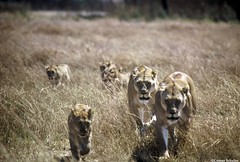
The main conservation measure discussed in the report is the installation of fences in and around Africa’s wilderness. Many scientists believe the best chance lions have to survive is to be separated from humans by wildlife-proof fencing. The largest threats lions face are from “human communities, including retaliatory killing by herders, habitat loss and fragmentation, and overhunting of lion prey” (Panthera). Even though the report shows that fences keep conservation costs lower and more lions survive in fenced-in ecosystems rather than unfenced, Dr. Luke Hunter explained that “No one wants to resort to putting any more fences around Africa’s marvelous wild areas [however,] without massive and immediate increases in the commitment to lion conservation, we may have little choice” (Panthera).

There will never be just one solution, but it’s clear that separating human and lion populations is essential for their ultimate survival. In addition to physical boundaries, Panthera conducts “conflict mitigation initiatives such as Project Leonardo and the Lion Guardians Program” in order to reduce lion-human conflict.

To learn more about all of Panthera’s programs to protect the world’s big cats, please visit Panthera.org.

On Earth Day this year, please remember that it’s not just your actions on this one day that matter, but the actions you take year-round to make a difference for the earth and all animals that call it home.

For more information on Earth Day 2013 and to find an Earth Day celebration in your area, please visit the Earth Day Network

Tuesday, October 30, 2012

The Last Asiatic Cheetahs Of Iran

When we hear Iran mentioned in the news, the images that immediately come to mind are war torn cities and military fighting; however, there is so much more to Iran than we know. Thinking of Iran, the one image that doesn't enter my mind is a cheetah, but there are Asiatic Cheetahs living and surviving in Iran’s “vast central plateau” (Hunter, National Geographic). There are only about 100 individuals left in Iran so they are extreme rarities among the desert landscapes. According to Dr. Luke Hunter, President of Panthera, “Iranian cats are virtually invisible […] intensely shy […] and hovering on the edge of extinction, they are essentially impossible to see” (Hunter, National Geographic).

Recently, National Geographic magazine published amazing photographs of wild Asiatic cheetahs in Iran gathered from those taken by camera-traps.  National Geographic was only able to photograph these rare cats due to an 11-year conservation project by the Iranian Department of Environment. In 2001, the DoE with support from the United Nations Development Programme, began a long-term project to bring the cheetah back from the edge of extinction. The Conservation of the Asiatic Cheetah Project (CACP) provided their own help by labeling five landscapes as specially protected cheetah reserves and provided numerous resources to make them remain safe havens—dozen of cheetah guards, new vehicles, motorbikes, and other materials. (Hunter, National Geographic)
Back in 2001, most Iranians had no idea their country harbored some of the Earth’s last Asiatic cheetahs, but now in cooperation with Panthera and local partners, the CACP sets out to protect the last Iranian cheetahs by
mitigating the direct threats facing cheetahs and their prey; gathering ecological data on existing cheetah, other carnivore and prey populations; enhancing and empowering law enforcement officials to protect cheetahs and their prey, including seeking a reduction in the number of annual gun licenses issued in cheetah range; researching the ecology of cheetahs, other predators and their prey using camera traps and radio-collars; studying cheetah rangelands to determine the extent of competition for land between livestock and the cheetah’s wild ungulate prey; establishing environmental educational activities with local communities to improve attitudes towards cheetahs; and engaging with local communities, conservation organizations and government officials to collaboratively protect cheetah habitat. (Hunter, Panthera)
In the past, the Asiatic cheetah’s distribution “extended across the Middle East, Central Asia, north into southern Kazakhstan and southeast into India;” however, today the cheetah has been pushed from almost its entire Asiatic range except for the “small and critically endangered population in the Islamic Republic of Iran” (Hunter, Panthera). The roughly 100 Asiatic cheetahs left in the wild occupy the “arid, central plateau of Iran” and face major threats which include: “overhunting of cheetah prey, habitat degradation and direct poaching” (Hunter, Panthera).
It’s important to get the word out about these elusive cats and to grab the attention of conservation organizations worldwide; that’s why the camera trap photos are so pertinent to the cheetahs’ survival. Currently, “Iranian cheetahs live at the lowest density recorded anywhere for the species, one to two cats per 1,000 square kilometers; the same-size area on East African plains can hold 100 cheetahs” (Hunter, National Geographic). National Geographic magazine’s article provides “evidence of residency and breeding including terrific pictures of young cubs” (Hunter, National Geographic). So, even though the cheetahs are at exceptionally low numbers, the camera trap photographs of the cheetahs and cubs provide hope for future populations.

Dr. Luke Hunter hopes that “National Geographic’s wonderful photographs bring the predicament of this critically endangered cat to a new audience who, like most Iranians a decade ago, had never heard of the cheetah’s existence in the country” (Hunter, National Geographic).

References
Hunter, Luke, Dr. "Finding the Last Cheetahs of Iran." News Watch. National Geographic, 25 Oct. 2012.Web. 30 Oct. 2012. 

Hunter, Luke, Dr. "Finding the Last Cheetahs of Iran." Panthera, 25 Oct. 2012. Web. 30 Oct. 2012.


Friday, September 28, 2012

Aerial Drones and Conservation

When it comes to wildlife conservation, much of it involves scientists searching through exotic forests and jungles collecting population data, setting camera traps, and surveying the ecosystem. As important as all this is, it takes up a lot of time and money. So the newest option for conservationists is to use aerial drones to assist them in surveying specific areas for wildlife and for human encroachment in the habitat.

By putting ‘an eye in the sky’ it’s easier to view large herds of elephants in Africa or the effects of deforestation on a habitat. A team of scientists working in Indonesia created “inexpensive unmanned aerial vehicles (aka drone airplanes), to study critically endangered Sumatran orangutans (Pongo abelii) from above the treetops” (Platt). This technology is already being used in other conservation projects around the globe.

Serge Wich, a professor at the Research Center in Evolutionary Anthropology and Paleoecology at Liverpool John Moores University, says “autonomous drones can help scientists and conservationists to inexpensively collect timely, high-resolution data” (Platt). Wich and his partner, Lian Pin Koh, assistant professor of applied ecology and conservation at ETH Zurich, “have developed a lightweight drone system that costs about $2,000—including the batteries, software, cameras and flight stabilizers” (Platt). Other available drones are much more expensive and can cost up to $5,000, but Wich and Koh set up a website, ConservationDrones.org, to help others recreate the same technology around the world.

Wich and Koh first used their drones in Sumatra “to capture video and photographs of orangutans and elephants. The drones also came back with striking images of Sumatra’s deforestation, caused by logging and palm oil plantations” (Platt). They also captured “photographs of orangutan nests high in the trees, information that will help inform future conservation activities” (Platt).

In an interview for the Scientific American blog, when asked what he was trying to solve with these drones, Wich replied that “one of the main problems we have is that we’re almost always behind the facts on the ground.” He goes on to describe how the conservation areas are just so huge and difficult to monitor regularly so the need for drones is high. The drones are available whenever they want to send them out, whereas conducting ground surveys takes time for planning and execution and the cost is considerably higher.

The beauty of the drones is that conservation researchers can choose to fly them as often as they like; for example, drones can fly over the forest every month or every week to see what’s going on. Then if there are any illegal activities or encroachment going on they can inform the local authorities. Wich hopes drones will enable conservationists “to react much faster to changes on the ground” than before (Platt).
Photo of deforestation

Eventually, as the drone technology advances, Wich wants to receive “live feedback from the video” instead of how it is now where he does not get access to video or photos until the drone returns from its flight (Platt). The drones currently operate with an autopilot route, much like Google Maps, that the researcher can plot himself. The next step after live video footage would be thermal imaging attached to the drone software.

Another example of aerial drones used in conservation is the research Panthera is currently conducting for the Jaguar Corridor Initiative. According to Panthera’s September newsletter, “one of the greatest resources shaping [Panthera’s] groundwork is aerial surveys carried out within Panthera’s Jaguar Corridor Initiative—a program working to connect and protect jaguar populations from Mexico to Argentina to ensure the species’ genetic diversity and future survival” (Panthera).
The drones offer “a unique perspective of the jaguar’s range, and a level of detail unmatched by satellite imagery, aerial surveys allow Panthera’s scientists to truly view connectivity of the Jaguar Corridor, identify encroachments on the jaguar’s range and pinpoint habitat in which to focus Panthera’s future conservation efforts.” The main threats targeted by these aerial drones are “habitat loss and fragmentation caused by increasing human populations and developments.” They also supply Panthera scientists with images to “visually demonstrate” to political leaders how the Corridor actually connects the jaguars throughout their range (Panthera).

In addition to population data, habitat status, and the health of the ecosystem, researchers hope drones will enable faster response times for antipoaching patrols. Panthera believes “local communities and local violators are recognizing the potential of aerial surveys to uncover otherwise unidentifiable illegal activities, and allow improved enforcements of forest protection laws.” Drones will definitely have a massive impact on the effectiveness of wildlife conservation around the world.


References:
Platt, John R. "Eye in the Sky: Drones Help Conserve Sumatran Orangutans and Other Wildlife,  Extinction Countdown, Scientific American Blog Network." Scientific American Blogs., 27 Sept. 2012. Web. 28 Sept. 2012. <http://blogs.scientificamerican.com/extinction-countdown/2012/09/27/drones-help-conserve-sumatran-orangutans-wildlife/>.

"September 2012 Newsletter." Panthera. Web. 28 Sept. 2012. <http://www.panthera.org/september-2012-newsletter>.

Monday, September 26, 2011

Happy International Tiger Day! 9.27.11


In celebration of International Tiger Day, I just want to remind everyone how important it is that tigers live on to future generations. Tigers deserve a place of honor in the wilderness they've called home for generations, not destined to be remembered only in movies like the Jungle Book.
Presently, Tigers’ futures lay in the balance, but with the help of the Save the Tiger Fund and Panthera, their futures are getting brighter. We need to remember that diversity of prey and safe habitat, while extremely important, are not the only factors affecting tigers today. Trophy hunting took a large portion out of tiger populations as well as the illegal wildlife trade. Hunting tigers for sport turns the death of a majestic creature into a prize to be won.

We need people who care about tigers to fight for what’s right. Anyone can become an animal ambassador; all it takes is the desire to see change and to educate those around you any chance you get.

We cannot let this gorgeous big cat disappear; demand results.

To learn more about the Save the Tiger Fund, visit here.
To learn more about Panthera, visit here.
To see a 2005-2015 recovery plan for the world’s wild tigers, visit here.

Make today the day you celebrate the natural beauty of wild tigers!

Tuesday, March 8, 2011

Panthera Foundation: Jaguar Corridor Initiative

About Panthera from Panthera Cats on Vimeo.

The jaguar is the largest and most iconic cat in the Western Hemisphere. Human societies and cultures across the region have evolved for centuries with the jaguar, a charismatic species that has inspired rich myths and legends, and today serves as a national symbol for several Latin American countries.”-Panthera


I first became aware of this amazing foundation while conducting research for one of my rhetoric classes. I came across an article published in National Geographic magazine in the March 2009 issue entitled “Path of the Jaguar” about the Panthera Foundation’s current project: the Jaguar Corridor Initiative. Mel White writes about Rabinowitz’s journey to create a safe passage for the jaguar through its homeland, “stretching from Mexico (and formerly the United States) to Argentina” (White); yet, this is not a new idea. The Wildlife Conservation Society paved the way for Rabinowitz in 1990 when it “launched a project called the Paseo Pantera (Spanish for ‘path of the panther’), a network of protected areas and wildlife corridors that became known as the Mesoamerica Biological Corridor (CBM) in 1997” (WCS). Many conservationists, however, were concerned with “its slow implementation and highly ambitious agenda” (WCS). Nowadays, Rabinowitz is having more success than the Wildlife Conservation Society did back in 1990. Rabinowitz and the Panthera Foundation have successfully protected the Mesoamerica component of the Jaguar Corridor, but will have to work even harder when it comes to South America “where landscapes and political situations are more diverse and challenging” (White).
Today, Panthera is still hard at work trying to make Alan Rabinowitz’s dream come true. In 2011, the goal is still the same; however, the problems are also still the same. As Panthera points out, “Jaguars, like many large, free-ranging wildlife species, are not constrained by political boundaries, nor are they as challenged or constrained by physical ones. Jaguars use and require protected areas, where their core populations can thrive” (Jaguar Corridor Initiative). Having safe passage from point A to point B sounds simple, but when these big cats move “through landscapes, across rivers, over hills and mountain passes and even through areas with human development” (JCI) things can get much more complex. Amongst the landscapes and rivers there may also be the occasional cattle ranch, citrus plantation, or someone’s backyard- anywhere jaguars can pass through safely and unharmed double as a jaguar corridor (JCI).

The three main problems that brought about a need for the Jaguar Corridor Initiative are:
1.      Dramatic habitat loss and fragmentation from wild lands being converted into agriculture
a.       With isolated patches of land, jaguars run the risk of being confined and are at greater risk for extinction.
2.      Direct hunting by people
a.       Ranchers especially because they see jaguars as a threat to their livelihood
3.      Lack of natural prey, like deer and wild pigs, due to overhunting by humans and habitat loss
a.       This fuels conflict between humans and jaguars because it forces the big cats to prey on domestic animals

The solution will not be easy to come by but with Panthera working in conjunction with “local communities, governments, and other conservation organizations every step of the way, to secure the long-term presence of jaguar populations and to ensure their safe passage from Mexico to Argentina” (JCI) it will come in time. 


In order to successfully preserve the Path of the Jaguar, the Jaguar Corridor Initiative is “built on a multi-dimensional process:”
1.      Map-based model of the jaguar’s ecological needs throughout its range.
2.      “Ground-truthing” corridors to verify where the jaguars are and where they are moving through
3.      Managing and conserving jaguar prey species
4.      Helping ranchers with livestock husbandry improvements
5.      Working with local communities to alleviate conflict between humans and jaguars
6.      Assisting governments with protected area management

As of now, jaguars exist in a total of 18 countries in Latin America and Panthera currently works in 13 of those countries, with plans to move into an additional two countries in the coming year (Panther’s Jaguar Footprint).  The 13 countries are: Mexico, Belize, Guatemala, Honduras, Nicaragua, Costa Rica, Panama, Colombia, Ecuador, Brazil, Argentina, Bolivia, and Paraguay. To see what Panthera is doing to expand the Jaguar Corridor Initiative in these 13 countries, please visit Panthera’s Jaguar Footprint.